
Summary:
You’ve got a flat roof that needs work, and you’re hearing two different recommendations: hot mop or TPO. Both protect against water. Both work on flat and low-slope roofs. But they’re built differently, installed differently, and perform differently over time. If you’re trying to figure out which system makes sense for your property in Los Angeles County, you need more than surface-level comparisons. You need to understand how hot mop roof materials actually work, what TPO membrane cost includes, and which one holds up better under Southern California’s relentless sun. Let’s break down what each system brings to the table.
Hot Mop Roof Materials: Complete System Overview
Hot mop roofing is a built-up roofing system (BUR) that’s been the go-to for flat roofs in Southern California for generations. It’s called “hot mop” because the installation involves heating asphalt to around 400 degrees Fahrenheit and mopping it across layers of roofing felt. The result is a thick, multi-layered membrane that creates a seamless waterproof barrier.
The system typically includes a base sheet mechanically fastened to the roof deck, followed by alternating layers of hot asphalt and reinforcing felt. Most hot mop installations use three to five plies, with each layer adding strength and redundancy. The top layer often gets finished with gravel or a mineral cap sheet to protect the asphalt from UV damage.
What makes hot mop roof materials different from newer flat roofing systems is the sheer thickness and physical toughness. You’re building up multiple layers that work together, which is why it’s also called built-up roofing or BUR. It’s heavy, labor-intensive, and requires specialized equipment and expertise to install correctly.
How Hot Mop Systems Handle Southern California Weather
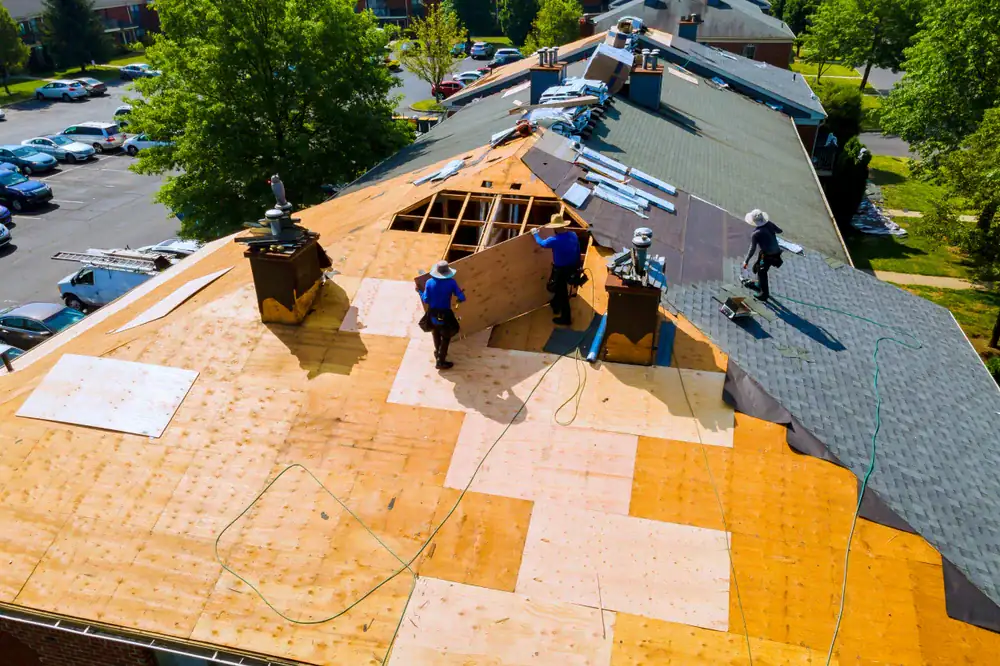
Los Angeles County gets about 263 sunny days a year, which means your roof is constantly getting hammered by UV radiation. Hot mop systems deal with this through their layered construction and protective top coat. The gravel or mineral surfacing acts as a shield, preventing direct UV contact with the asphalt layers underneath.
The asphalt itself is inherently fire-resistant, which matters in a region where wildfire risk is real. The multi-layer design also gives you redundancy. If one layer develops a small crack or blister, the layers beneath it continue protecting the building. That’s different from single-ply systems where a puncture goes straight through.
Temperature swings between day and night can stress roofing materials through expansion and contraction. Hot mop handles this reasonably well because the multiple layers distribute that stress. The asphalt stays somewhat flexible when it’s warm, though it can become more brittle in extreme cold. Since Los Angeles rarely sees freezing temperatures, that’s less of a concern here than it would be in other climates.
The trade-off is weight. Hot mop systems are heavy, so your building structure needs to support that load. Most commercial buildings and properly framed residential flat roofs can handle it, but it’s something to verify before installation. The other consideration is ponding water. Any flat roof needs proper drainage, but hot mop systems can develop issues if water sits in one spot for extended periods. Proper installation with adequate slope and drainage is critical.
What Goes Into Hot Mop Roof Cost
Hot mop roof cost typically runs between $5 and $10 per square foot installed, though you’ll see variations based on the number of layers, roof complexity, and who’s doing the work. A standard three-ply system on a straightforward roof will land on the lower end. Add more plies, deal with multiple penetrations like vents and HVAC units, or work on a roof with difficult access, and costs climb.
Material costs include the asphalt itself, which runs around $100 to $200 per ton when purchased in bulk, plus roofing felts at roughly $0.50 to $1.50 per square foot. The gravel or mineral surfacing adds another $0.10 to $0.25 per square foot. Labor is where hot mop gets expensive. You’re paying for skilled crews who know how to handle molten asphalt safely, spread it evenly, and time each layer correctly. Labor typically accounts for $3 to $6 per square foot of the total cost.
For a typical 2,000 square foot commercial flat roof, you’re looking at somewhere between $10,000 and $20,000 for a complete hot mop installation. Smaller residential projects might see higher per-square-foot pricing because of mobilization costs and minimum job sizes. If you need to tear off an existing roof first, add another $1 to $2 per square foot for removal and disposal.
The installation process takes time. A straightforward hot mop job might be done in one to two days, but complex roofs with lots of details can stretch to three to five days. Weather matters too. You can’t install hot mop in the rain, and extreme heat can affect working conditions. The smell is noticeable during installation, though it dissipates within hours once the crew finishes.
One thing to understand about hot mop roof cost in Los Angeles County: there aren’t as many contractors who specialize in this system anymore. The trade has shifted toward single-ply membranes in many markets, which means finding a crew with real hot mop expertise matters. A general roofer who dabbles in hot mop won’t deliver the same results as a specialist who’s been doing it for decades.
TPO Membrane Cost vs Hot Mop System Comparison
TPO stands for thermoplastic polyolefin, and it’s a single-ply roofing membrane that’s become increasingly popular for commercial and residential flat roofs. Instead of building up multiple layers like hot mop, TPO comes in large sheets that get heat-welded together at the seams. The result is a continuous waterproof surface that’s significantly lighter and faster to install than built-up systems.
TPO membrane cost varies more widely than hot mop, ranging from about $4.50 to $16 per square foot installed. The range depends on membrane thickness (45 mil, 60 mil, or 80 mil), whether you’re adding insulation, and the complexity of the installation. A basic TPO roof without additional insulation might land in the $7 to $10 range, while a full system with code-required insulation and premium materials pushes toward the higher end.
The installation process is cleaner and faster than hot mop. There’s no kettle of hot asphalt, no odor, and fewer safety concerns. A skilled crew can cover a lot of square footage quickly because they’re rolling out large sheets rather than building up layers. That speed translates to lower labor costs in many cases, though TPO requires different expertise. The heat welding needs to be done correctly to create watertight seams.
TPO Performance in Los Angeles County Climate
TPO’s biggest advantage in Southern California is its reflectivity. White TPO roofs reflect a significant portion of the sun’s heat, which keeps the building cooler and reduces air conditioning costs. In a climate where cooling expenses dominate energy bills, that reflective property delivers real savings. Many white TPO systems are ENERGY STAR rated specifically for their ability to reduce heat absorption.
The membrane is also highly resistant to UV rays, which is critical when you’re getting 263 days of sun exposure per year. Unlike asphalt-based systems that can break down under constant UV bombardment, TPO is engineered to handle it. The material resists tears and punctures reasonably well, though it’s thinner than a multi-ply hot mop system. An 80 mil TPO membrane is tougher than a 45 mil version, but even the thickest TPO is still a single layer.
TPO lasts 20 to 30 years with minimal maintenance when installed correctly. That’s comparable to or slightly better than hot mop in terms of longevity. The difference is that TPO tends to fail more gracefully. Seam issues are the most common problem, and they’re usually repairable. Hot mop systems can develop blisters or cracks that require more extensive patching.
One consideration with TPO is that it’s a relatively newer material compared to hot mop’s century-long track record. Formulations have improved significantly over the past two decades, but there were some early TPO products that didn’t hold up as well as expected. That’s why working with a reputable manufacturer and experienced installer matters. The quality of the membrane and the installation technique both affect long-term performance.
TPO also handles ponding water better than hot mop in many cases, though proper drainage is still essential for any flat roof. The welded seams create a truly watertight barrier when done right, whereas hot mop relies on the overlapping layers and asphalt adhesion.
When Hot Mop Makes More Sense Than TPO
Hot mop still has specific advantages that make it the better choice for certain situations. If your building has heavy foot traffic on the roof, hot mop’s thickness and durability hold up better than single-ply membranes. Commercial buildings with rooftop HVAC units, maintenance walkways, or equipment that gets serviced regularly benefit from hot mop’s physical toughness.
The system also works well on roofs with lots of penetrations and complex details. Because you’re building up the layers with hot asphalt, you can create custom flashing and waterproofing around vents, drains, and equipment that’s difficult to achieve with sheet goods. Skilled hot mop installers can work around obstacles and create seamless transitions that TPO installers might struggle with.
Cost can favor hot mop on the lower end, particularly if you’re doing a straightforward three-ply system without insulation. While TPO can be cheaper per square foot in some configurations, a basic hot mop job from an experienced contractor often comes in at a competitive price point. You’re also getting a proven system with a long track record in Southern California specifically.
Some property owners simply prefer the redundancy of a multi-layer system. There’s a psychological comfort in knowing you have three to five layers protecting your building rather than one membrane. If a contractor nicks a single-ply roof during installation or maintenance, you’ve potentially compromised the waterproofing. With hot mop, you’d have to cut through multiple layers before reaching the deck.
The other scenario where hot mop makes sense is when you’re working with a contractor who specializes in it. We’ve been installing hot mop systems since 1982, with factory-certified crews who understand how these materials perform in Southern California’s climate. That specialized knowledge means better installation quality, faster problem-solving if issues arise, and a crew that’s done thousands of hot mop roofs rather than treating it as an occasional project. When you’re comparing contractors, the one who specializes in the system you’re choosing will almost always deliver better results than a generalist.
Insurance compliance is another factor. Some insurance companies and building codes have specific requirements around roofing systems, and hot mop’s long history means it’s well-understood by underwriters and inspectors. If you’re dealing with an insurance claim or need to meet specific fire ratings, hot mop’s established track record can simplify approvals.
Choosing the Right Flat Roof System for Your Property
Hot mop roof materials and TPO membranes both protect flat and low-slope roofs effectively, but they do it differently. Hot mop gives you a thick, multi-layer system with proven durability and excellent performance on high-traffic roofs. TPO offers a lighter, more reflective option that can reduce energy costs and installs faster. Your choice comes down to building type, budget, and who’s doing the installation.
If you’re in Los Angeles County and dealing with a flat roof decision, talk to someone who specializes in the system you’re considering. We’ve been installing hot mop systems since 1982, with factory-certified crews who understand how these materials perform in Southern California’s climate. Whether you’re leaning toward traditional hot mop or exploring TPO options, working with a C-39 licensed specialist ensures you get a roof that’s installed right the first time.