


Summary:
Most roofs in Orange County and Los Angeles County don’t fail during a normal rain year. They fail during El Niño — when Southern California gets 150 to 200 percent of its normal annual rainfall in a matter of weeks, with no drying time between storms. That’s when the tile that shifted slightly two years ago becomes an active leak. That’s when the gutter joint that separated over the summer backs water up under your fascia. By the time you see a stain on the ceiling, the damage is already weeks old. This post explains what actually goes wrong, how we approach pre-season preparation, and what to look for when you’re choosing who to call.
Why El Niño Exposes Roofing Problems That Normal Rain Years Miss
Southern California’s climate is unusually forgiving for roofs — right up until it isn’t. Extended dry seasons mean a roof can have cracked mortar, failing underlayment, or a gutter pulling away from the fascia for two or three years without producing a single visible leak. The roof appears fine. Nothing drips. There’s no obvious reason to call anyone.
El Niño changes that equation entirely. When atmospheric river events deliver three to eight inches of rain over 48 to 72 hours — back to back, with no time for saturation to clear — every hidden vulnerability gets tested simultaneously. The dry years didn’t protect your roof. They just delayed the moment of reckoning.
How a Clogged Gutter Becomes a Structural Leak
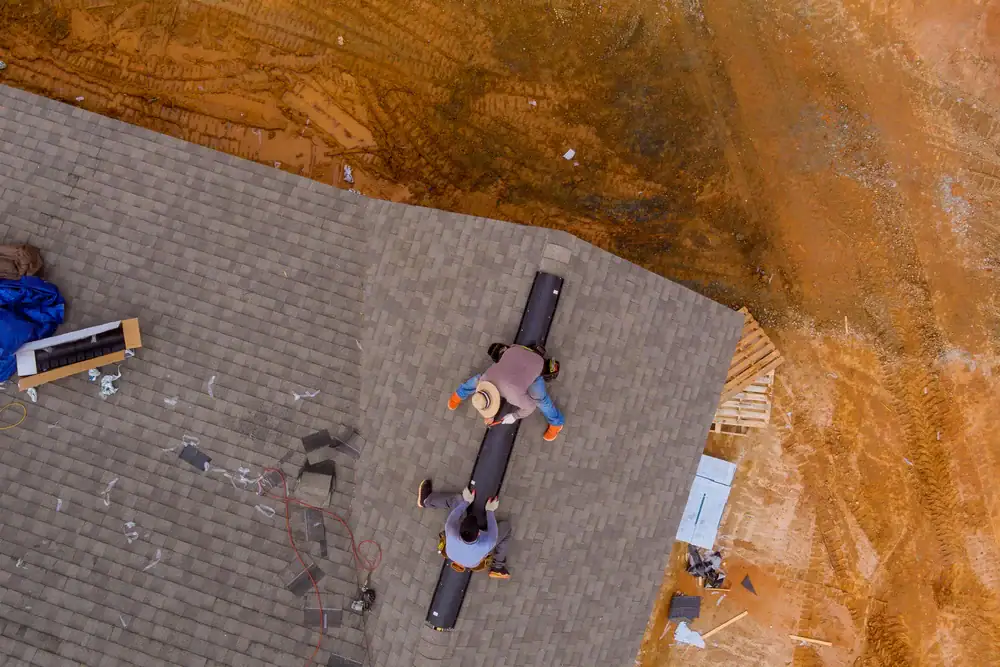
The failure chain we see most often in Orange County and Los Angeles County doesn’t start on the roof surface. It starts in the gutters. Over a long dry season, debris accumulates — leaves from the eucalyptus trees common in Irvine and Mission Viejo neighborhoods, palm frond material along coastal communities from Huntington Beach to Newport Beach, dust and seed pods in the canyon communities around Yorba Linda and Anaheim Hills. By the time October arrives, many gutters are partially or fully blocked.
When the first heavy El Niño rain hits, that clogged gutter can’t drain fast enough. Water backs up, pools at the gutter line, and begins working its way under the lowest course of tiles or shingles. From there it saturates the fascia board — the horizontal board running along your roofline — and then the soffit material behind it. Wood rot sets in quickly once that material stays wet through multiple storm cycles. What started as a drainage problem has now become a structural repair.
This is why we don’t treat gutters as an afterthought during pre-season inspections. On a tile roof, especially the clay and concrete tile profiles common throughout Orange County’s Mediterranean and Spanish Colonial architecture, the gutter line is one of the most critical water management points on the entire structure. A clean, properly pitched, securely fastened gutter system is doing real work every time it rains.
Coastal properties add another layer of complexity. Salt air from Seal Beach through Laguna Beach accelerates corrosion on gutter joints, hangers, and the fasteners holding everything to the fascia. A gutter that looks intact from the ground can have corroded connections that fail under the weight of standing water. That’s something a visual check from a ladder — done by someone who knows what corroded aluminum hardware looks like — will catch. A drive-by estimate won’t.
What a Tile Slip Actually Is — and Why It's More Than a Cosmetic Problem
Roughly one-third of Los Angeles County’s housing stock is clay or concrete tile, and the proportion is even higher in Orange County’s planned communities. Tile is durable, fire-resistant, and well-suited to Southern California’s climate. It’s also commonly misunderstood by homeowners who assume that because the tiles themselves are intact, the roof is fine.
The tile is not the waterproofing layer. The underlayment beneath the tile — typically a hot mop system or a multi-layer felt assembly on older structures — is what actually keeps water out of your home. The tile’s job is to protect that underlayment from UV degradation, foot traffic, and direct rain impact. When a tile slips out of position, even partially, it exposes the underlayment to direct rainfall. Under normal California rain conditions, that exposure might not matter much. Under El Niño conditions, with sustained rainfall over multiple days, it absolutely does.
Tile slips happen for several reasons. Mortar beds — the material used to set ridge and hip tiles — dry out and crack over time, especially under Southern California’s UV intensity and temperature swings. In foothill communities like Yorba Linda and Silverado, Santa Ana wind events in October and November routinely dislodge tiles that were already sitting loosely. HOA communities in Irvine, Laguna Niguel, and Mission Viejo often have tile profiles that were installed 20 to 30 years ago, and the original mortar has long since reached the end of its useful life.
When we inspect a tile roof ahead of the rainy season, we’re not just looking at whether tiles are present. We’re checking mortar integrity at ridges and hips, looking for tiles that have shifted even slightly from their original position, and — critically — inspecting the underlayment in any area where there’s been movement. That last step is what separates a real pre-season inspection from a surface-level walk-around.
How to Choose a Licensed Roofer in Orange County Before El Niño Season
After a major El Niño event, the number of roofing contractors operating in Southern California grows quickly. Some are established, licensed, and accountable. Others arrive after storms, collect deposits, do substandard work, and are difficult or impossible to reach when problems surface. This pattern is well-documented in California’s construction market, and it’s one of the reasons the state requires a C-39 roofing license for any job exceeding $500 in labor and materials.
Verifying a C-39 license takes about two minutes at the CSLB’s public database at cslb.ca.gov. You can look up any contractor by name or license number and see whether their license is active, how long it has been held, and whether any complaints or disciplinary actions are on record. That last part matters as much as the license itself.
What 42 Years of Clean CSLB Licensing Means for Orange County Property Owners
We’ve held CSLB C-39 License #432352 continuously since 1982. That’s over four decades of active licensing with zero disciplinary citations, zero complaints, and zero violations on record. You can verify this yourself at cslb.ca.gov — it’s public information, and it tells you something meaningful about how we operate over time.
A clean license history over 42 years means we’ve consistently carried proper insurance, maintained qualified crews, resolved disputes professionally, and stayed accountable to the standards California sets for licensed contractors. For property owners throughout Orange County and Los Angeles County — where homes in Newport Beach, Laguna Niguel, and Los Alamitos regularly exceed $1 million in value — that track record matters.
We also hold dual GAF Master Elite and GAF Master Commercial certifications simultaneously — a combination that places us in the top 2% of roofing professionals in North America. These aren’t self-reported credentials. GAF requires active licensing, adequate insurance, a demonstrated reputation, and a commitment to ongoing training before awarding either designation. Holding both at once is genuinely uncommon.
Our crews are direct employees — not subcontractors hired for a specific job. Every roofer on every project holds factory certifications from GAF, Owens Corning, or CertainTeed. We carry $2 million in general liability insurance plus full workers’ compensation coverage. For high-value properties throughout Orange County and Los Angeles County, that level of coverage isn’t optional. It’s the minimum a responsible property owner should require.
For HOA communities in Irvine, Mission Viejo, and Laguna Niguel, there’s an additional layer of complexity that many contractors aren’t prepared for. HOA boards typically require tile-match approval before any roofing work proceeds, and sourcing a discontinued tile profile from a 25-year-old installation requires the kind of supplier relationships and product knowledge that comes from decades in the Southern California market.

Why Flat Roofs and Hot Mop Systems Need Attention Before the Rains Hit
A significant portion of the commercial and industrial properties we serve across Los Angeles County — particularly in the Bell Gardens, Long Beach, and southeast LA corridor — have flat or low-slope roofs. Flat roofs handle water differently than pitched roofs. Instead of shedding rainfall, they’re designed to drain it through a system of interior drains and scuppers. When those drains are clogged or the membrane has developed low spots, water ponds on the surface.
Ponding water is one of the most damaging conditions a flat roof can experience. Even a small amount of standing water adds significant weight to the roof structure and, over time, accelerates membrane degradation at the precise point where water is collecting. Under El Niño conditions — with sustained rainfall over multiple days — a flat roof that ponds even slightly can accumulate enough water to stress the structural deck beneath. A small undetected leak in a commercial flat roof can become a $20,000-plus interior damage claim after the first major storm.
Hot mop roofing — a built-up system using hot-applied asphalt layers — is one of the most common flat-roof assemblies in Southern California, and it’s a system we’ve specialized in for decades. Hot mop systems are durable and well-suited to the climate, but they require specific maintenance attention before the rainy season. The asphalt layers can develop surface cracks over time from UV exposure and thermal cycling. Flashing at parapet walls, HVAC curbs, and drain collars are the points most likely to fail under sustained water pressure. These are the areas we prioritize during pre-season commercial roof inspections.
We also document everything. Before, during, and after photos formatted for insurance compliance are part of how we work — not something we offer as an add-on. For commercial property managers and HOA boards with fiduciary responsibility for their buildings, that documentation is the difference between a straightforward insurance claim and a disputed one. Eighty-six percent of our business comes from repeat clients or referrals rather than advertising, which tells you how property managers in Orange County and Los Angeles County view the work we do.
Getting Your Orange County or Los Angeles County Roof Ready Before El Niño Arrives
The window between now and the start of Southern California’s rainy season is the right time to address what you can’t see from the ground. Cracked mortar beds, shifted tiles, corroded gutter hardware, degraded flat-roof membranes — these are the vulnerabilities that El Niño finds. Waiting until after the first storm means waiting until the damage has already started.
A proper pre-season inspection looks at the full picture: tile integrity and underlayment condition, gutter drainage and attachment, flat-roof drain clearance and membrane health, flashing at every transition point, and any area where the previous season left evidence of water movement. That’s not a 20-minute walk-around. It’s the kind of thorough assessment that gives you an honest picture of where your property actually stands.
If you’re in Orange County or Los Angeles County and want to get ahead of El Niño season with a real inspection from a contractor who has been doing this work in Southern California since 1982, reach out to Royal Roofing Company. We’re straightforward about what we find, and we’ll tell you what actually needs attention before the rains arrive.