

Summary:
Every El Niño season, the same thing happens. Homeowners and property managers across Los Angeles County and Orange County call us after the ceiling is already stained, the insulation is already soaked, or a tile section has already let in a week’s worth of rain. The damage was rarely caused by the storm alone. It was caused by a roof that had been quietly deteriorating through months of intense UV exposure and Santa Ana wind stress — and the storm was just the thing that finally made it visible.
If you’re reading this before that happens, you’re in the right place. Here’s what actually goes into preparing a roof for El Niño — and what separates a contractor who can help from one who can’t.
What El Niño Actually Does to Roofs in Southern California
El Niño doesn’t just bring more rain. It brings concentrated, heavy rain — often three to eight inches over 48 to 72 hours — after months of conditions that have been quietly degrading your roof’s ability to handle it. Southern California’s long, hot summers bake the oils out of asphalt shingles, dry out sealants, and stress every flashing joint on the roof. Then Santa Ana winds arrive in the fall, sometimes sustaining above 50 mph in foothill communities across Orange County like Yorba Linda and Silverado, potentially lifting tiles and separating flashing before a single storm cloud forms.
By the time El Niño rainfall arrives, a roof that looks intact from the street may already have vulnerabilities that a normal rain year would never expose. That’s the trap. The storm gets blamed, but the damage was already in motion.
Why Flashing Failures Are the Most Common Source of Leaks During Heavy Rain
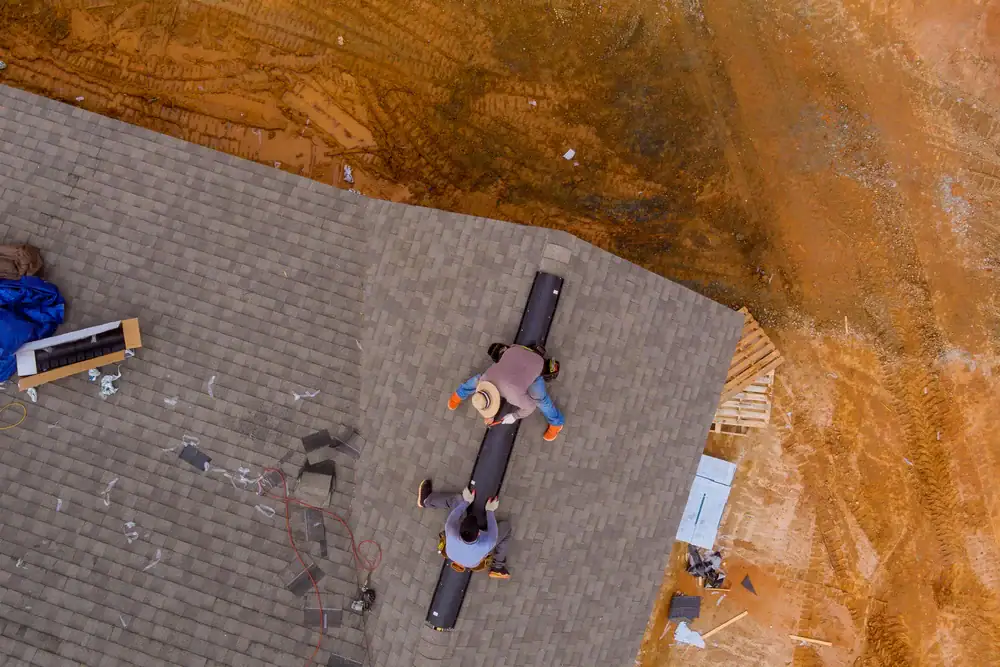
If you ask us where most leaks start during a heavy storm, the answer is almost always flashing. Flashing is the metal material installed around chimneys, skylights, vents, and wall intersections — the transition points where the roof meets something else. These are the spots where water naturally wants to find a path inward, and they’re the spots that deteriorate fastest under UV exposure, thermal cycling, and wind stress.
During a normal rain year, a slightly compromised flashing joint might allow a small amount of moisture intrusion that dries out before it causes visible damage. During an El Niño event, that same joint gets tested repeatedly over days, not hours. The water finds the gap. It follows the path of least resistance into your decking, your insulation, and eventually your ceiling.
This is why a proper pre-storm inspection isn’t just a visual scan of the shingles from the ground. It means getting eyes on every flashing location — chimney base, skylight perimeter, roof-to-wall transitions — and checking the sealant condition, the fastener integrity, and whether the flashing itself has lifted, corroded, or separated. In coastal communities from Long Beach to Newport Beach, salt air accelerates metal corrosion in ways that aren’t always visible until you’re looking closely.
For homes with tile roofs — and there are a lot of them across Orange County and the older neighborhoods of southeast LA County — the flashing concern is compounded by the underlayment beneath the tile. Concrete and clay barrel tile can last 50 years or more, but the underlayment beneath it typically reaches the end of its reliable life in 25 to 30 years. The tile looks fine. The water barrier underneath it may not be. That’s not something a homeowner can assess from the driveway, and it’s not something a roofer can evaluate without actually getting on the roof.
Flat Roofs, Hot Mop Systems, and the El Niño Risk in LA County's Commercial Corridors
Los Angeles County has one of the highest concentrations of flat commercial roofs in the country. The industrial and commercial corridors running through communities like Bell Gardens, Commerce, Maywood, and Vernon are full of older buildings with built-up roofing systems — many of them original hot mop installations that have been in service for decades. These systems are durable when properly maintained, but they have specific failure points that El Niño conditions exploit.
The biggest risk on a flat or low-slope roof is ponding water. Flat roofs are designed with slight drainage slopes, but over time, structural settling, membrane deterioration, and clogged drains can cause water to pool. During a normal rain year, a shallow pond might evaporate before it causes a problem. During an El Niño event, sustained rainfall fills that pond faster than it can drain, adds significant weight load to the structure, and eventually finds every pinhole, seam separation, or membrane crack in the system.
For apartment buildings, commercial properties, and multi-family housing across LA County, a flat roof leak isn’t just a property problem — it’s a tenant problem, a liability problem, and potentially an insurance problem if the damage wasn’t documented before it occurred. We photograph every roof we inspect and every job we complete. If a claim needs to be filed, the documentation exists. If a tenant disputes when damage occurred, the timeline is clear.
Pre-storm maintenance on a flat roof typically involves clearing all drains and scuppers, inspecting seams and penetrations, and evaluating whether any sections of membrane have begun to separate or blister. On older hot mop systems, we look at the condition of the gravel surface, the integrity of the base sheet, and whether any areas have developed soft spots that indicate moisture has already infiltrated the assembly. Catching these issues in September or October is a completely different conversation — in cost and in disruption — than catching them in January when the roof is actively leaking into a tenant-occupied space.
How to Choose a Roofer in LA County or Orange County Before El Niño Season
The roofing industry in Southern California has a well-documented problem with unlicensed contractors, misleading bids, and subcontracted crews that have no connection to the company you actually hired. El Niño seasons make this worse, because the urgency of an incoming storm creates exactly the conditions that bad actors exploit.
Choosing the right residential or commercial roofing contractor before the season hits — not during it — is the most important decision you can make. Here’s what actually matters when you’re evaluating who to call.
How to Verify a Roofing Contractor's License in California Before You Hire
California requires a C-39 specialty roofing contractor license for any roofing work exceeding $500. That license is issued by the Contractors State License Board, and every licensed contractor’s record — including their license number, license status, insurance filings, and any disciplinary actions, citations, or complaints — is publicly searchable at cslb.ca.gov. This takes about 90 seconds and tells you more about a contractor than any website or brochure ever will.
What you’re looking for is a license that has been active continuously under the same business name, with no disciplinary actions and no complaints on record. License continuity matters because name changes are a common way for contractors with poor records to start fresh. A company that has been operating under the same name, from the same address, with the same license number for decades is telling you something meaningful about how they run their business.
We’ve held C-39 License #432352 continuously since 1982 — over 40 years under the same name, from the same Bell Gardens location, with zero citations, violations, or disciplinary actions on record. You can verify that yourself right now.
Beyond the license, ask about insurance. A legitimate roofing contractor carries both general liability and workers’ compensation coverage. Workers’ comp matters specifically because if an uninsured worker is injured on your property, you can be held liable. We carry $2 million in general liability coverage and full workers’ compensation — and we’ll provide the certificate of insurance before any work begins.

What Does a GAF Master Elite Certification Actually Mean for Your Roof?
You’ve probably seen roofing contractors advertise manufacturer certifications, and you may have wondered whether they actually mean anything or whether they’re just marketing badges. The honest answer is that they vary — and the differences matter more than most homeowners realize.
GAF Master Elite is the highest tier of certification that GAF — one of the largest roofing manufacturers in North America — awards to contractors. Achieving it requires maintaining proper state licensing, carrying adequate insurance, demonstrating a proven reputation, and committing to ongoing technical training. GAF estimates that only about two percent of roofing contractors nationally reach this level. The practical benefit for the homeowner is access to extended manufacturer warranties that GAF does not offer through uncertified installers. That means if the materials fail within the warranty period, the manufacturer stands behind them — not just the contractor.
We hold both the GAF Master Elite and the GAF Master Commercial certifications simultaneously, which places us in the top two percent of roofing professionals in the country. We also hold factory certifications from Owens Corning and CertainTeed, meaning we can offer extended manufacturer warranties from all three major manufacturers depending on the materials used on your project.
For HOA boards in communities like Irvine, Mission Viejo, and Rancho Santa Margarita — where roofing decisions involve collective approval processes and need to be defensible to all members — these credentials matter beyond the individual project. They document that the contractor selected meets a verifiable, nationally recognized standard of qualification.
One more thing worth knowing: every crew member who works on your roof is a direct employee of ours, not a subcontractor. Every one of them holds factory certifications. We’ve built 86 percent of our business on repeat and referral clients. That number doesn’t happen when you’re sending strangers to people’s homes.
Ready to Get Your Roof Checked Before the Rains Hit LA and Orange County?
The best time to call a roofer in Los Angeles County or Orange County is before you have a reason to panic. An inspection that finds nothing wrong costs you a couple of hours and gives you real peace of mind heading into El Niño season. An inspection that finds something gives you time to fix it on your schedule, at normal pricing, with a crew that isn’t stretched thin responding to emergency calls across two counties.
We’ve been doing this since 1982. We’ve watched multiple El Niño cycles come through Southern California, and we know exactly what they reveal about roofs that looked fine the summer before. We’re not going to manufacture urgency or recommend work you don’t need — our referral rate is built on being straight with people, not on closing every estimate we run.
If you own a home, manage a commercial property, or sit on an HOA board in LA County or Orange County and you’re not certain your roof is ready for what’s coming, reach out to Royal Roofing Company. We schedule free estimates within one to three business days, and we’ll give you a straight answer about what we find.