
Summary:
Most commercial roofs in Southern California look fine — right up until they don’t. That’s the problem with flat roofs in a climate like ours. Eight or nine months of dry weather can mask cracked seams, blocked drains, and failing membrane sections that only reveal themselves when the first sustained rain of the season arrives. By then, the water is already inside. If you manage a commercial property, an HOA, or a multi-family building in Orange County or Los Angeles County, the time to find out your roof has a problem is not during an El Niño storm. Here’s what you actually need to know.
What El Niño Actually Does to Commercial Flat Roofs in Orange County and Los Angeles County
El Niño is a periodic shift in Pacific Ocean temperatures that drives above-average rainfall across Southern California — typically occurring once every two to seven years and lasting up to twelve months. For most of the year, the region’s semi-arid climate keeps roofing problems invisible. Then El Niño compresses the wet season into a series of heavy, sustained events that expose every deferred maintenance issue at once.
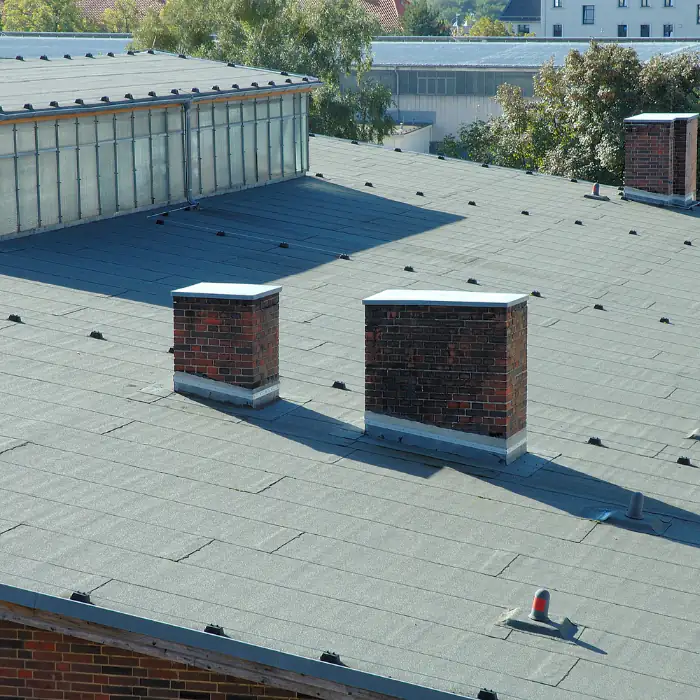
Flat and low-slope commercial roofs are the most vulnerable building type in this scenario. Unlike pitched roofs that shed water quickly, flat roofs rely on drainage systems, membrane integrity, and properly sealed penetrations to keep water moving. When any one of those elements fails, water doesn’t run off — it sits. And standing water on a commercial flat roof is where the expensive problems begin.
Why Ponding Water on a Flat Roof Is a Bigger Problem Than It Looks
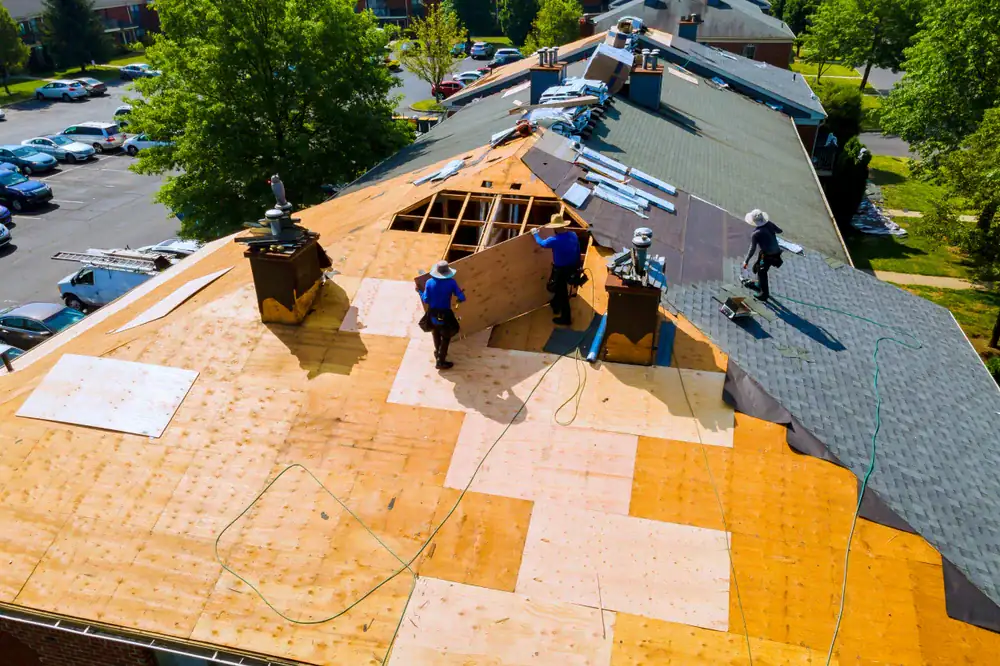
Ponding water — water that remains on a flat roof surface more than 48 hours after rainfall — is one of the most misunderstood problems in commercial roofing. Property managers often see it and assume it’s cosmetic. It isn’t.
Standing water adds significant weight to a roof structure that wasn’t designed to carry it indefinitely. Over time, it accelerates the breakdown of roofing membranes, works its way into seams and penetrations, and creates the conditions for mold growth inside the building. In a worst-case scenario, structural deterioration can follow. What starts as a drainage issue becomes a liability.
In a normal Southern California wet season, a small amount of ponding might come and go without causing visible interior damage. But during an El Niño event — when rainfall is heavier, more frequent, and sustained over weeks rather than days — a roof with marginal drainage simply doesn’t get a chance to recover between storms. The cumulative effect is what turns a $500 maintenance fix into a $20,000-plus interior damage claim.
This is especially relevant for the commercial and industrial building stock across Los Angeles County. Much of it was constructed in an era when flat roofs were the standard — built-up roofing systems, hot mop applications, and modified bitumen membranes that are now aging and approaching the end of their serviceable life. Many of those buildings haven’t had a thorough roof inspection in years. Some have never had one.
In Orange County, the issue is compounded by coastal exposure. Properties in Newport Beach, Huntington Beach, Seal Beach, and Laguna Beach face salt air corrosion on metal flashing and HVAC penetrations year-round. By the time El Niño arrives, those vulnerable points have often been quietly degrading for months. A pre-storm inspection catches them. A post-storm emergency call costs far more.
How Do You Know If Your Commercial Roof Is Actually Ready for Heavy Rain?
This is the question most property managers don’t ask until they’re standing inside a building watching water drip from the ceiling. The honest answer is that you can’t know without a professional inspection — and not just any inspection. A meaningful commercial roof assessment looks at the full system: membrane condition, seam integrity, drain flow, flashing around HVAC units and penetrations, and any areas where water might be pooling or where the surface shows signs of prior patching.
What a thorough inspection is not is someone walking the perimeter, glancing at the surface, and telling you it looks fine. That’s the kind of assessment that leads to emergency calls in January.
A qualified commercial roofing contractor will document what they find with photographs — not because it’s a nice touch, but because that documentation matters. Insurance carriers increasingly require evidence of maintained roof condition before processing claims or renewing commercial policies. If your roof fails during an El Niño event and you can’t demonstrate that it was professionally maintained, you may find your claim disputed. This is a growing reality for commercial property owners across both Orange County and Los Angeles County, and it’s one of the reasons photo-documented inspections have moved from a best practice to a near-necessity.
HOA boards face a version of this same challenge. Common area roofing on multi-family buildings and clubhouses falls under the association’s maintenance responsibility. When a leak causes interior damage to a unit or common space, the board needs documentation showing the roof was properly maintained. Without it, the liability conversation gets complicated fast.
The other thing worth understanding is contractor selection. A general C-39 roofing license covers a wide range of work, but commercial flat roof systems — particularly those requiring manufacturer-backed warranties — call for factory certification specific to those systems. A contractor who occasionally handles flat roofs is not the same as one who specializes in them and holds the certifications to prove it.
What to Look for in a Commercial Roofing Contractor in Orange County and Los Angeles County
The roofing market in Southern California is crowded. After every major storm, it gets more crowded — with operators who appear quickly and disappear just as fast. For commercial property managers and HOA boards who need a contractor they can trust before a weather event, the filtering process matters.
Start with the basics: a valid California C-39 roofing license, verifiable on the CSLB website. Then go further. Ask how long the license has been active, whether there are any citations or complaints on record, and what manufacturer certifications the contractor holds. Those questions eliminate a significant portion of the field immediately.
Why Manufacturer Certifications Matter for Commercial Flat Roof Work
This is where a lot of commercial property owners get caught off guard. They hire a licensed contractor, the work gets done, and then they discover the manufacturer warranty they expected isn’t valid — because the contractor wasn’t certified to install that system.
Factory certifications aren’t just marketing credentials. They’re the mechanism through which manufacturers extend their highest-tier warranties to property owners. Without them, you may be getting the materials but not the coverage. And on a commercial flat roof, that coverage is often the difference between a manageable repair and an out-of-pocket replacement.
GAF, the largest roofing manufacturer in North America, offers two distinct commercial certifications: Master Elite and Master Commercial. Holding both simultaneously places a contractor in the top two percent of roofing professionals nationwide. We hold both. That means when we install a commercial roofing system on a property in Irvine, Anaheim, Long Beach, or anywhere else in Orange County and Los Angeles County, the manufacturer warranty we can offer is the strongest available.
For property managers evaluating contractors, this is a concrete, verifiable differentiator. You can check GAF’s contractor locator directly. You can look up our CSLB license — C-39 #432352, active since 1982, with no disciplinary actions, citations, or complaints on record. These aren’t claims. They’re public records.
Every technician we send to a job site is a direct employee, factory-certified by GAF, Owens Corning, or CertainTeed. There’s no handoff to a crew you’ve never met. That accountability matters, especially when you’re protecting a commercial asset in a region that faces sustained rainfall during El Niño season.
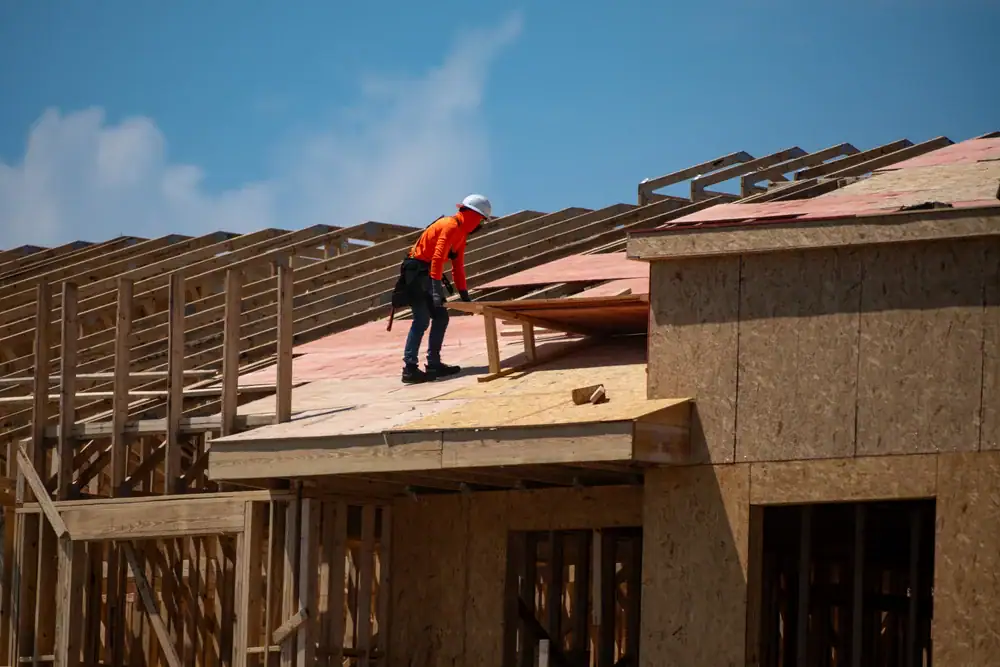
Hot Mop Roofing in Los Angeles and Orange County — Why It Still Matters
If your commercial or multi-family building was constructed before the 1990s, there’s a reasonable chance it has a hot mop roof — also called a built-up roofing system. These systems were the standard for decades across Southern California, and they’re still in service on thousands of buildings throughout Los Angeles County and Orange County.
Hot mop roofing involves layers of roofing felt and hot-applied asphalt, built up to create a waterproof membrane. When properly installed and maintained, it’s a durable system. When it ages without attention, the layers separate, the asphalt becomes brittle, and the waterproofing fails — often in ways that aren’t visible from the ground.
Most general roofing contractors don’t specialize in hot mop systems. It’s a technical discipline that requires specific knowledge and equipment, and it’s increasingly rare to find contractors who do it well. We’ve been doing hot mop work since we started in this region, and it’s particularly relevant for the older commercial and apartment building stock in cities like Bell, Commerce, Huntington Park, and throughout the southeast Los Angeles County corridor — as well as older commercial strips in Garden Grove, Anaheim, and Santa Ana in Orange County.
The reason this matters heading into an El Niño season is straightforward: aging hot mop roofs are among the most vulnerable systems when sustained rain arrives. The failure points are predictable — seam separation, flashing failures, drain blockages — and they’re also preventable with the right inspection and maintenance. Waiting until there’s an active leak is the most expensive version of this problem. A pre-season assessment that catches those failure points early is a fraction of the cost.
Before El Niño Hits, Get a Roof Inspection That Actually Means Something
The window to prepare a commercial flat roof for a Southern California wet season is real — and it closes faster than most property managers expect. Once contractor schedules fill up and the first storms arrive, you’re in reactive mode. Reactive mode costs more, takes longer, and happens at the worst possible time for your tenants, your board, or your business operations.
If you manage a commercial property, an HOA, or a multi-family building in Orange County or Los Angeles County, a pre-season roof inspection is the most straightforward way to know where you stand. Not a surface-level walkthrough — a documented, professional assessment that gives you something to show your insurance carrier if it comes to that.
We’ve been doing this work across Orange County and Los Angeles County since 1982. We’ve completed over $75 million in roofing projects — commercial buildings, industrial properties, multi-family complexes, and upscale residential homes. Eighty-six percent of our business comes from repeat clients and referrals.
If you want to talk through what your roof actually needs before the rain arrives, give us a call at (562) 928-1200.