

Summary:
Water’s dripping through your ceiling. The storm’s still going. You’re watching the damage spread in real time.
The instinct to grab a tarp and fix it yourself is understandable. But here’s what most Los Angeles homeowners don’t realize until it’s too late: roof tarping looks straightforward until you’re actually up there—on a wet, possibly damaged surface, in unpredictable conditions, without the equipment that keeps professional roofers from becoming statistics.
This isn’t about scaring you away from every repair. It’s about knowing the line between what you can safely handle and when calling our emergency team is the smarter move. Let’s start with what actually makes emergency roof tarping work—and what makes it fail.
Tarping a Roof Leak: Safety and Effectiveness
A properly installed tarp stops water intrusion, prevents mold growth, and buys you time to arrange permanent repairs. The key phrase there is “properly installed.”
Professional roof tarping in Los Angeles involves more than throwing a blue tarp over the hole. It requires extending coverage at least four feet beyond the damaged area on all sides, anchoring into solid sheathing rather than loose shingles, and creating drainage paths that shed water downhill without pooling or blow-under.
When done right, a tarp protects your home for up to 90 days. When done wrong, it tears loose in the next wind gust, rips additional shingles off on its way down, or traps water against your roof deck causing worse damage than the original leak. That’s not a hypothetical—it’s what we see constantly after failed DIY attempts.
Roof Leaks in Heavy Rain: Why Every Minute Counts
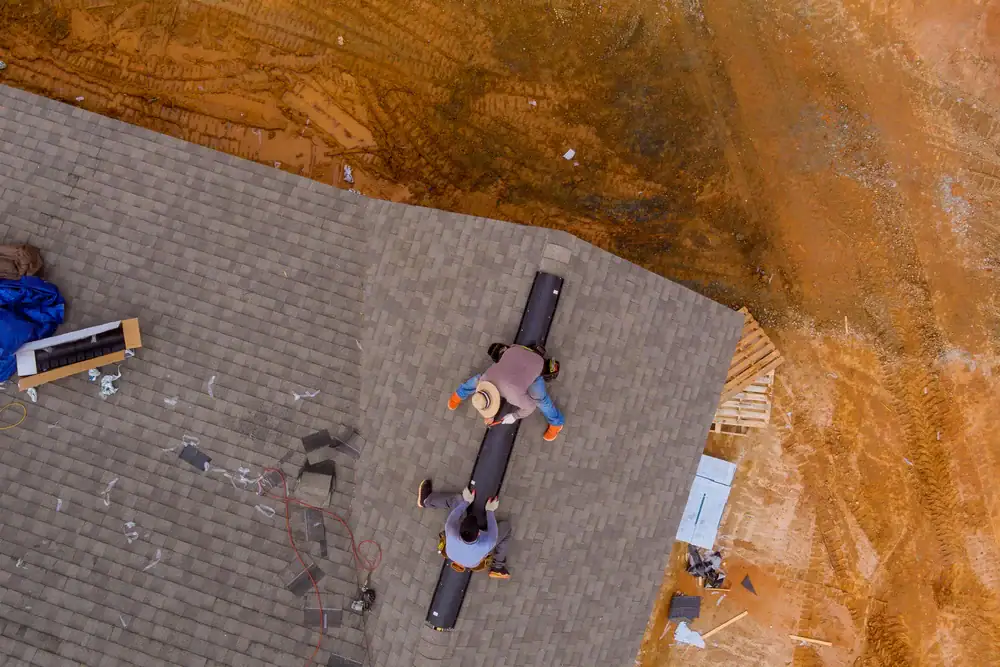
Los Angeles gets months of dry weather, then atmospheric rivers dump inches of rain in hours. Your roof either handles it or it doesn’t. When it doesn’t, every minute counts.
Here’s what happens inside your home when a roof leak goes unaddressed during heavy rain: water finds the path of least resistance through your attic insulation, along ceiling joists, and into drywall. Within 24 hours, mold spores start colonizing damp materials. Within 48 hours, wood framing begins absorbing moisture. Within a week, you’re looking at structural issues that cost exponentially more than the original leak.
This time pressure is exactly why homeowners feel compelled to climb up there themselves. The problem is that roof leaks in heavy rain create the most dangerous tarping conditions possible. Wet shingles are slippery. Wind gusts are unpredictable. Visibility is poor. And if your roof was damaged enough to leak, there’s a real chance the decking underneath is compromised—meaning it might not support your weight where you’d expect.
Insurance companies in California require you to mitigate damage within 24 to 72 hours of a covered event. That’s not optional. But “mitigation” doesn’t mean risking your life on a wet roof in active weather. It means protecting your interior with buckets and tarps from inside, documenting everything with photos, and getting a licensed contractor out as soon as conditions are safe. We respond to true emergencies within 2 to 4 hours specifically because we understand this timeline.
The data on DIY roof tarping during storms is sobering. Falls from roofs are one of the leading causes of construction-related injuries and deaths. Professional roofers use harnesses, anchor points, and safety protocols developed over decades. Most homeowners have a ladder and good intentions. That gap is where people get hurt.
When DIY Roof Tarping Makes Sense (and When It Doesn't)
There’s a narrow window where DIY tarping is actually reasonable. Small damaged area—under 100 square feet. Low-slope roof—less than a 6:12 pitch, which means six inches of vertical rise for every 12 inches of horizontal run. Dry conditions. Stable surface. Proper safety equipment including a secured ladder and someone spotting you from the ground.
Even then, you’re looking at $150 to $350 in materials for a proper DIY job. That includes a minimum 6-mil thick polyethylene tarp (12-mil is better for Los Angeles wind conditions), 2×4 lumber for securing, roofing nails, washers, and safety gear. You’ll spend 2 to 4 hours on installation if everything goes smoothly. And you’ll need to inspect it after every weather event because DIY tarps have a 40 percent failure rate in high winds compared to about 15 percent for professional installations.
Now contrast that with situations where DIY tarping is genuinely dangerous: roof pitch steeper than 6:12, damage covering more than 100 square feet, structural issues like sagging or exposed framing, multiple roof sections needing coverage, active weather conditions, or wet surfaces. In any of these scenarios, the risk of serious injury outweighs any cost savings. Period.
Here’s what most people don’t factor into the DIY calculation—if your tarp fails, you’re paying for the original damage plus whatever the failed tarp caused plus the professional tarping you should have gotten in the first place. And if you get injured in the attempt, you’re adding medical bills to that total. The math stops making sense pretty quickly.
Professional emergency roof tarping from us runs $350 to $800 for residential properties in Los Angeles County, CA depending on roof area and access difficulty. That includes commercial-grade materials, proper installation that survives Santa Ana winds, full insurance documentation for your claim, and the peace of mind that comes from 40 years of emergency response experience. When you’re already stressed about a leaking roof, that difference in cost starts looking like the bargain it actually is.
When to Call an Emergency Roofer vs DIY Solutions
The decision between handling it yourself and calling us comes down to three factors: safety, skill, and stakes.
Safety is non-negotiable. If you’re uncomfortable with heights, lack proper equipment, or the conditions are anything less than ideal, don’t go up there. If the roof is wet, it’s a hard no. If there’s any wind, it’s a hard no. If you can see structural damage from the ground, it’s a hard no.
Skill matters more than confidence. Knowing how to secure a tarp so it doesn’t tear loose requires understanding roof geometry, water flow patterns, and anchoring techniques. Most homeowners overestimate their ability here, which is how you end up with tarps that last three days instead of three months.
Emergency Roofing Solutions: What We Do Differently
When we respond to an emergency call in Los Angeles County, CA, the process looks different from what most homeowners attempt on their own.
First, we assess from the ground and attic before anyone sets foot on the roof. That inspection identifies not just the obvious damage but also hidden issues like compromised decking, weakened framing, or secondary leak points that aren’t visible from below. We’re looking for problems that could make the roof unsafe to walk on or that would cause a tarp to fail.
Second, we use commercial-grade materials designed for extended protection in Southern California conditions. That means reinforced polyethylene or vinyl tarps rated for 50-plus mph winds—common during Santa Ana wind events in Los Angeles. We’re not using the lightweight blue tarps from hardware stores that shred in a week. The materials alone make a measurable difference in how long your temporary protection actually lasts.
Third, we anchor into solid sheathing using proper fastening techniques. Tarps secured to shingles pull loose. Tarps weighted down with sandbags or bricks blow off. Professional installation means lumber battens screwed through the tarp into the roof deck, creating a mechanical connection that holds even in severe weather. We extend coverage well beyond the damage perimeter and create drainage paths that prevent water from pooling or working its way underneath.
Fourth, we document everything with photos. That documentation serves two purposes: it gives you a clear record for your insurance claim, and it provides a baseline for assessing any changes or additional damage later. Insurance adjusters in California specifically look for this kind of professional documentation when evaluating emergency mitigation claims. According to the Insurance Information Institute, documenting damage professionally before filing significantly improves claim approval rates.
Finally, we provide a written damage assessment and explain your options for permanent repair. You’re not just getting a tarp—you’re getting a clear path forward from someone who’s handled thousands of these situations over 40-plus years in Los Angeles County, CA.

Emergency Roofing Solutions: Insurance and Cost Realities
Most California homeowners insurance policies cover storm-related roofing emergencies, including the cost of emergency tarping to prevent further damage. But there’s a process, and understanding it prevents expensive mistakes.
Your insurance company expects you to mitigate damage promptly—usually within 24 to 72 hours of the covered event. That means you can’t just leave a gaping hole in your roof and wait weeks for an adjuster. You have to take reasonable steps to protect your property. Professional emergency tarping qualifies as reasonable mitigation. DIY tarping qualifies too, as long as you document it properly and save receipts.
Here’s where it gets tricky: if you make repairs before the insurance adjuster inspects the damage, you might complicate your claim. The solution is emergency tarping as a temporary measure, thorough photo documentation before any work starts, and professional assessment that creates a paper trail. We handle this documentation process specifically because we know what insurance companies in Los Angeles County, CA require.
The cost difference between DIY and professional tarping narrows significantly when you factor in insurance reimbursement. If your policy covers emergency mitigation, you’re paying your deductible either way. The question becomes whether you want to risk your safety and potentially void warranties to save a few hundred dollars that insurance would have covered anyway.
Emergency roof tarping costs in Los Angeles typically run $350 to $800 for residential properties. That’s roughly 30 percent more than standard tarping services because of the urgency, after-hours response, and prioritized scheduling. But compare that to the cost of water damage spreading through your home for even one additional day—ruined ceilings, damaged flooring, mold remediation, destroyed belongings—and the economics shift dramatically.
Acting within the first 24 hours after roof damage consistently leads to lower total repair costs and stronger insurance outcomes. That’s not opinion—that’s what the data shows across thousands of emergency roof repairs in Southern California. The homeowners who call us immediately spend less overall than those who delay or attempt inadequate DIY solutions.
Making the Right Call When Your Roof Is Leaking
Roof leak emergencies put you in a position where you have to make fast decisions with incomplete information. The pressure is real. The stakes are high. And the difference between a smart choice and an expensive mistake often comes down to knowing your limits.
Small repairs in safe conditions might be DIY-appropriate if you have the skills and equipment. Everything else benefits from professional help. That’s not upselling—it’s the reality of what works and what doesn’t when your home is taking on water.
We’ve spent 40-plus years responding to emergencies across Los Angeles County, CA. We understand the local weather patterns, the common roof types, the insurance requirements, and most importantly, how to protect your property without creating new problems. When you’re facing an active leak and need reliable guidance, that experience matters.